
In modern business, every missed call can mean a lost customer. Whether it is a potential sale, an urgent intervention, or a simple inquiry, the moment nobody answers is often the moment when the customer moves to a competitor. The problem is that most companies still depend on employee availability, working hours, and overloaded phone lines.
As a company grows, communication becomes more complex. Calls, messages, emails, and requests arrive from all directions, while information is often lost or left unprocessed. Customers repeat the same details several times, employees record data in different places, and there is almost no complete overview of communication.
In that kind of environment, the problem is not only that someone failed to answer the phone. The problem goes much deeper: communication is not structured, processes are not connected, and information does not have a clear flow.
The problem is not the phone - the problem is the system.
A new model of communication
Because of these challenges, more and more companies are moving to a different approach to customer communication. Instead of relying only on employee availability, they introduce a new layer: intelligent systems that take over the first contact and guide the conversation in a structured way.
This is where AI voice agents appear: systems that can talk to customers in real time, understand their needs, and collect key information. Unlike classic call centers, this is not only about answering the phone. It is about guiding the entire communication through a clearly defined flow.
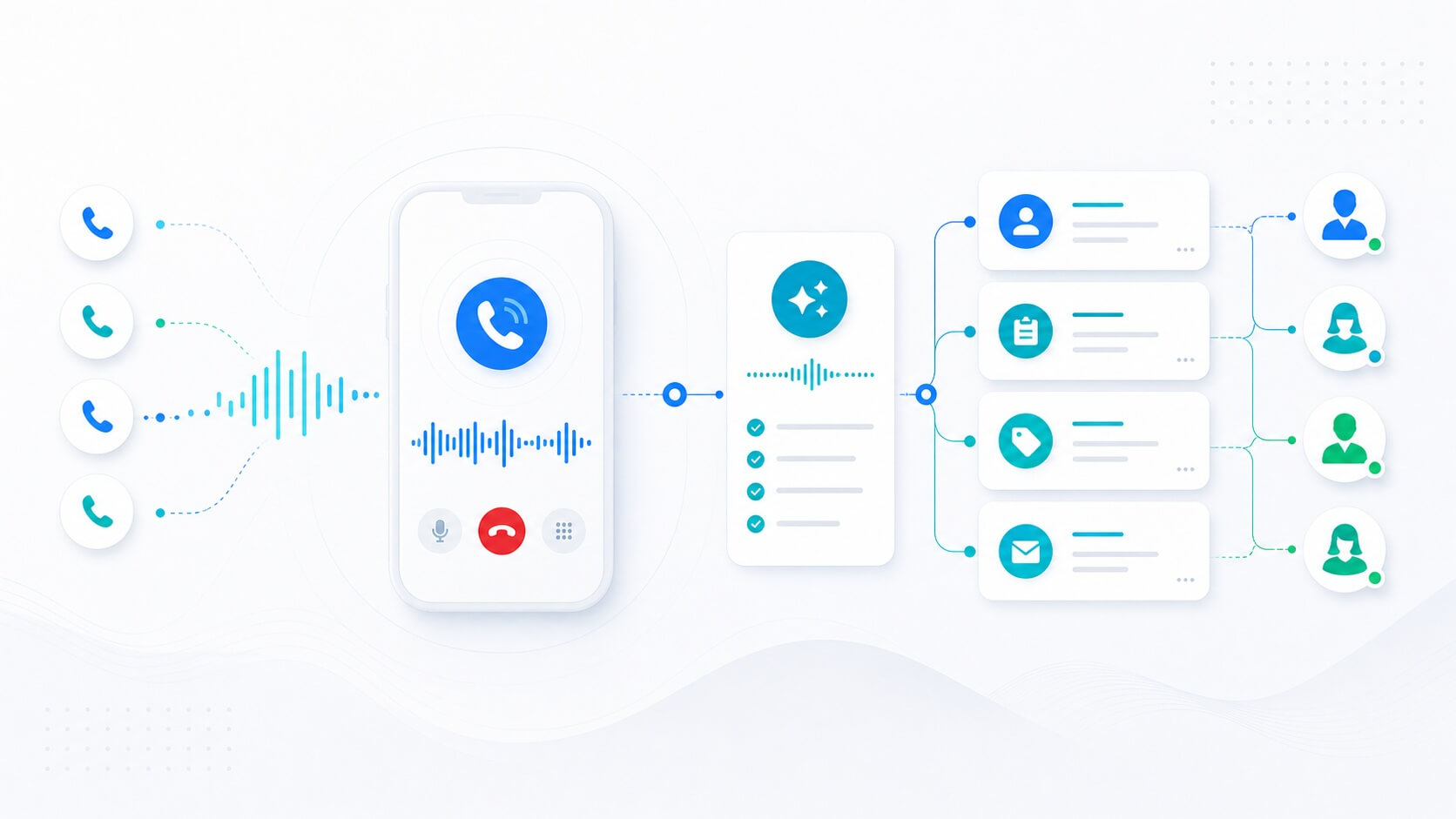
This approach introduces the concept of a digital entry point for the company. Every call, regardless of when it happens, enters a system that processes it, classifies it, and routes it further - without losing information and without depending on chance.
In the new model, every call becomes a structured request that can be processed, tracked, and automated.
What are AI voice agents?
AI voice agents are software systems that can lead a natural phone conversation with customers in real time. Unlike classic automated phone menus, they understand what the user is saying, ask follow-up questions, and adapt the flow of the conversation depending on the situation.
In practice, this means that an agent can recognize the reason for the call, collect all necessary information, and guide the caller through the process - whether it is a maintenance request, a service inquiry, or scheduling an appointment. The conversation is no longer only communication; it becomes a way to collect accurate and useful data.
The greatest value comes after the call. Everything the customer said can be automatically recorded, structured, and forwarded further - to a CRM system, work orders, or internal processes. In this way, communication becomes part of the company's operating system, not an isolated event.
Not all AI voice agents are the same
As the AI voice agent market grows quickly, many platforms appear to be similar at first glance. However, the differences between them are significant - both in the way they are implemented and in the capabilities they offer.
To understand what you really need, it is important to distinguish the basic categories of these systems. In practice, most AI voice platforms can be grouped into three main categories.
No-code platforms
(Voiceflow, Synthflow)
These platforms are designed to make it possible to launch quickly without programming. The interface is usually visual, and agents are created through predefined conversation flows.
The main advantages are speed and simplicity. It is possible to create a basic voice agent in a relatively short time. However, as needs become more complex, these systems can show limitations in flexibility and integrations.
Ideal for: testing an idea, MVP projects, and simple use cases.
Developer / real-time voice platforms
(Retell AI, Bland AI)
These platforms are intended for companies that want greater control over the way their AI voice agent works. Instead of predefined flows, they use an API-based approach, which allows deeper integration with existing systems.
They support technologies such as SIP trunking, webhooks, and direct connections with CRM and other business tools. This means that the agent does not only guide the conversation; it can also trigger concrete actions inside the system - from creating a task to starting automated processes.
This approach brings greater flexibility and makes it possible to build more complex solutions, but it also requires more technical knowledge or developer support.
Ideal for: companies that want serious automation and integration with existing systems.
Enterprise systems
(PolyAI)
Enterprise platforms are intended for large companies with complex processes and a high volume of communication. These systems are usually adapted to specific client needs and implemented through detailed projects that can last for weeks or months.
The main advantage of these solutions is a high level of customization and stability when handling a large number of calls. However, implementation and maintenance costs are significantly higher, and the integration itself requires serious resources and planning.
Ideal for: large systems, corporations, and companies with large call centers.
ElevenLabs - a new generation of voice agents
Among the available solutions on the market, ElevenLabs stands out as a platform that pushes the boundaries of what an AI voice agent can be. Its technology enables an extremely natural and realistic voice, to the point where the conversation can feel almost indistinguishable from communication with a real person.
What makes ElevenLabs especially powerful is the ability to lead real-time conversations while understanding context and adapting responses during the call. The agent does not follow rigid scripts; it dynamically guides the user through the conversation and collects all relevant information.
The platform supports SIP trunk integrations, which means it can connect directly with the company's existing phone infrastructure. In addition, multiple agents can be organized within one system, each with its own role in the process - from initial call reception to specific operational tasks.
Combined with LLM models and RAG systems, ElevenLabs becomes much more than a voice interface. The agent gets access to company knowledge, can provide precise information, and can make decisions based on available data.
ElevenLabs is not only voice - it is the foundation for a complete AI call center.
For companies that want automation, this means the following: the system works 24/7, does not miss calls, and turns every conversation into concrete, usable data. Instead of lost information and unorganized communication, the company gets a clear flow - from the first contact to the next process inside the business.
Advantages
- extremely realistic voice and natural conversation
- real-time communication without noticeable delay
- SIP trunk integrations with existing systems
- support for multiple agents and workflow logic
- possibility to connect with LLM + RAG systems
Limitations
- requires initial setup and understanding of the system
- advanced functionality requires technical integration
Who it is ideal for
- companies that want full communication automation
- companies that want to introduce an AI call center
- organizations that want structured data from every call
Retell AI - an engine for serious voice applications
Retell AI is a platform designed from the beginning with a developer-oriented approach. Unlike no-code tools, the focus here is on speed, control, and the ability to build advanced voice systems that work in real time.
One of Retell's key advantages is very low latency, which enables a natural conversation flow without pauses. In the context of voice agents, this is crucial because every delay directly affects the user experience.
The platform supports API access, SIP integrations, and connections with systems such as Twilio, which allows full control over call flows and integration with existing infrastructure. This means that a voice agent can be part of a wider system that includes CRM, automation, and internal processes.
Retell AI can best be described as an engine for serious voice applications - flexible, fast, and ready for complex use cases.
Advantages
- very low latency and a natural conversation flow
- developer-first approach and full flexibility
- API, SIP, and Twilio integrations
- suitable for real-time voice applications
- scalable for larger systems
Limitations
- requires technical knowledge or a development team
- not ideal for quick no-code implementations
Who it is ideal for
- companies building advanced voice applications
- teams that want full control over the system
- companies integrating voice into existing processes
Voiceflow - a visual approach to creating AI agents
Voiceflow is a platform that makes it possible to create AI agents through a visual interface, without programming. Instead of writing code, users design the conversation flow through blocks, which significantly speeds up development and makes the overall logic easier to understand.
This approach makes Voiceflow ideal for quickly testing ideas and building MVP solutions. The platform is often used for a combination of chatbot and voice scenarios, where it is important to define the basic communication flow quickly and validate how users respond.
However, as systems become more complex and require deeper integration with business processes, this model can show limitations. Flexibility and control over advanced logic are not at the same level as developer-first platforms.
Advantages
- visual flow creation without coding
- fast MVP development
- easy to understand and use
- good combination of chatbot and voice scenarios
Limitations
- limited flexibility for complex processes
- less control in advanced integrations
Who it is ideal for
- companies that want to quickly test AI agents
- teams without development resources
- projects where implementation speed is important
Synthflow - launching AI voice agents quickly without coding
Synthflow is a platform focused on simplicity and fast implementation. It enables the creation of AI voice agents without technical knowledge, which makes it accessible to a wide range of users.
The setup is fast and intuitive. In a relatively short time, it is possible to launch a functional agent that can answer calls and lead basic conversations. That is why Synthflow is often chosen by companies that want to introduce AI into their communication quickly, without a complex implementation process.
However, as needs grow and processes become more complex, this approach can have limitations. Advanced automation, complex integrations, and detailed control over logic are not the primary focus of this platform.
Advantages
- very simple setup
- no-code approach without programming
- fast deployment and quick launch
- accessible for beginners
Limitations
- limited for advanced automation
- less flexibility in complex systems
Who it is ideal for
- companies that want to introduce an AI voice agent quickly
- small teams without technical resources
- simple use cases and basic automation
Bland AI - automation and scaling for outbound calls
Bland AI is a platform that stands out especially in outbound communication. Unlike many solutions focused on incoming calls, Bland allows companies to automate customer calling at a large scale.
This includes scenarios such as sales calls, reminders, surveys, and follow-up communication. The platform is designed for scaling, which means it can handle a large number of calls at the same time without increasing the team.
However, Bland AI is primarily focused on the calling process itself, while less emphasis is placed on data structuring and integration with wider business processes. This makes it highly useful for specific scenarios, but less suitable as the central communication system of a company.
Advantages
- strong focus on outbound calls
- ability to scale significantly
- automation of sales and informational calls
- efficient for campaigns and follow-up
Limitations
- less focused on data and process structure
- limited as a central entry point system
Who it is ideal for
- companies running outbound campaigns
- sales teams that want call automation
- companies that want to scale communication
PolyAI - an enterprise solution for large systems
PolyAI is a platform developed for large companies with complex operations and a high volume of communication. It is focused on enterprise-level implementation, where AI voice agents are adapted to the specific needs of the organization and integrated into existing systems.
These solutions are usually introduced through carefully planned projects that include process analysis, model customization, and integration with internal tools. The result is a stable and scalable system that can handle a large number of calls with a high level of reliability.
However, precisely because of its complexity and implementation model, PolyAI is not intended for smaller companies. Costs, implementation time, and required resources make it suitable primarily for large organizations and corporations.
PolyAI is not for small companies - it is for systems that already have developed infrastructure and large operational requirements.
Advantages
- enterprise-level stability and reliability
- high level of customization
- capable of handling a large number of calls
- suitable for complex systems
Limitations
- high implementation cost
- long integration process
- requires significant resources
Who it is ideal for
- large companies and corporations
- systems with large call centers
- organizations with complex processes
The question is not which tool to use - but what you do with calls
After reviewing different AI voice platforms, it is easy to get the impression that choosing the tool is the most important decision. In practice, however, that is not the decisive factor. Most modern systems today can lead a conversation and answer basic customer questions.
The real difference appears in what happens after the conversation.
Today, almost all systems can "talk". Fewer of them truly understand context and recognize what the user wants. Even fewer can turn that information into concrete actions inside the company.
- Everyone can talk.
- Few truly understand.
- Even fewer automate.
This is exactly where the line between a tool and a system appears. If the conversation ends without a clear outcome - without recorded data, without a started process, and without further processing - the value of the AI agent remains limited.
On the other hand, when every call becomes a structured request that enters the next workflow, communication becomes part of the company's operating system. Then the AI voice agent stops being only a digital operator and becomes a key component of the business.
AI entry point - when communication becomes a system
Most companies today think about AI voice agents as a replacement for the person who answers the phone. However, the real potential of this technology goes much deeper - into the way communication connects with the rest of the business.
The concept of an AI entry point means that every call becomes an entry point into the company's system. Instead of an isolated conversation, every interaction becomes structured data with a clear flow - from reception, through processing, to a concrete action.
In this model, the voice agent is not only a communication channel, but part of the workflow. Information collected during the conversation is automatically classified, recorded, and forwarded further - to CRM, tasks, work orders, or other processes inside the organization.
The result is a completely different way of operating: no lost information, no repeating the same questions, and no dependence on chance. Every contact with a customer has its purpose and a clearly defined continuation.
When communication is set up in this way, the AI voice agent stops being a tool - and becomes the foundation of the company's operating system.
What is the next step?
If you have reached this part, you are probably already thinking about what an AI voice agent could look like in your business. The good news is that implementation does not have to be complicated - but it does need to be set up correctly from the very beginning.
Instead of choosing only a tool, the focus should be on how communication will fit into your processes, how data will be used, and how every call will become a concrete action.
If you want to see what an AI entry point would look like in your company, we can show you a concrete example, adapted to the way you work.
Frequently asked questions about AI voice agents
Can an AI voice agent fully replace a call center?
In certain cases, yes, especially for routine inquiries and receiving information. However, it is most often used as the first level of communication that filters and organizes requests.
How difficult is it to implement an AI voice agent?
Basic versions can be set up quickly, but serious automation and integration with business systems require a good structure and a clear plan.
Can an AI voice agent understand Serbian?
Yes. Modern systems increasingly support Serbian, including speech understanding and voice generation.
Which AI voice agent is the best?
There is no universally best tool. The right choice depends on the company's needs, the level of automation, and the integrations that are required.
How much does an AI call center cost?
The price varies depending on the platform, number of calls, and system complexity. There are solutions for small companies, as well as enterprise systems with larger budgets.
Is it legal to use an AI voice agent?
Yes, but it is important to respect data protection laws and inform users that they are speaking with an AI system, in accordance with local regulations.
How does an AI voice agent connect with a CRM system?
An AI voice agent can connect with CRM systems through API integrations and webhooks, which enables automatic data recording and the start of further processes.